Wheel bolt patterns explained
The bolt pattern is the first fitment gate any wheel has to pass. Get it wrong and nothing else matters — the wheel simply won't bolt on.
What a bolt pattern is
A bolt pattern — also called the PCD, or pitch-circle diameter — is two numbers: how many lugs the wheel has, and the diameter of the circle those lugs sit on. Written 5x112, it means five lugs on a circle 112 mm across.
Both numbers have to match your car exactly. A wheel with the right lug count but the wrong circle diameter won't line up; a wheel with the right diameter but a different lug count simply won't fit. There is no "close enough" here — 5x112 and 5x114.3 are only 2.3 mm apart and they do not interchange. This is the one spec where you match or you move on.
How to measure your bolt pattern
If you have the wheel off, or a tape measure and a steady hand, you can read the pattern yourself:
- 4- and 6-lug wheels: measure straight across, centre of one lug to the centre of the lug directly opposite. That distance is your PCD.
- 5-lug wheels: no two holes sit directly opposite, so you can't measure straight across. Measure from the centre of one hole to the outer edge of the hole two positions away — that reads your PCD directly. Or measure from the hub centre to one stud centre and double it.
When in doubt, don't guess. The surest sources are the number stamped on your OEM wheel, the vehicle handbook, the door-jamb sticker, or a VIN lookup. A tape measure gets you close; the manufacturer's figure gets you certain.
Two related numbers matter too. The centre bore — the big hole in the middle of the wheel — must be at least as large as your car's hub. If the wheel's bore is larger, hub-centric rings fill the gap so the wheel sits centred on the hub instead of hanging on the studs, which keeps it running true.
Common bolt patterns by make
These are common examples to orient you — not a fitment guarantee. Bolt patterns change across generations and trims, so always verify your exact year and trim before you buy.
| Pattern | Often found on (verify your year & trim) |
|---|---|
4x100 | Older MINI (R50/R53), many older Honda Civic, Mazda MX-5 (NA/NB) |
5x100 | VW Golf Mk4, many older Subaru, first-gen Toyota 86 / Subaru BRZ |
5x112 | Audi, Volkswagen (Mk5 on), Mercedes-Benz, newer BMW, newer MINI |
5x114.3 | Honda, Toyota, Nissan, Mazda, Hyundai/Kia, Ford Mustang, Tesla Model 3/Y — the most common pattern in the catalog |
5x120 | Older BMW (many E- and F-chassis), Tesla Model S / Model X |
6x139.7 | Many trucks & body-on-frame SUVs — Toyota Tacoma & 4Runner, Chevrolet/GMC Colorado |
Notice how close 5x112, 5x114.3 and 5x120 look on paper. A few millimetres is the whole difference between "bolts right up" and "doesn't fit" — which is exactly why the number has to be exact.
A word on adapters and wobble bolts
Adapters and "wobble" or radius-variable bolts exist to bridge a mismatched pattern, and yes, people use them. But every adapter is another set of parts between your hub and your wheel — more mating surfaces, more torque to check, another potential failure point on a part that keeps you off the road. The safest approach is simple: buy wheels made in your car's pattern. If you do go the adapter route, use quality hardware rated for your car and have it fitted and torqued professionally. This isn't a corner to save money on.
How WheelPeek checks it for you
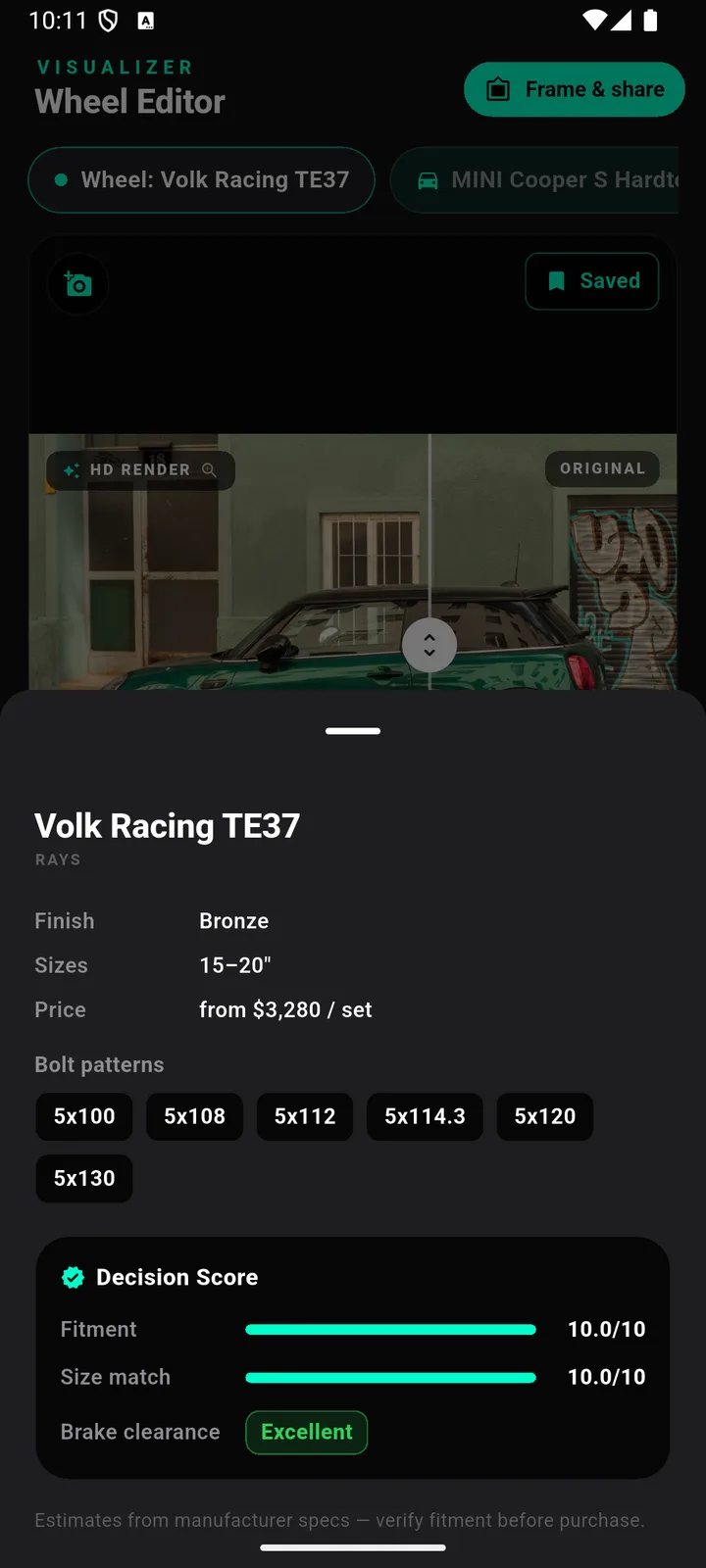
You don't have to hold every number in your head. Every wheel in WheelPeek carries the manufacturer's real bolt-pattern list, and once the app reads your car's pattern it does the matching for you: a FITS badge on compatible wheels, plus a Decision Score that rates fitment from 0 to 10 against your car's detected pattern. Running a swapped hub or a different stud pattern? A custom fitment override lets you tell the app what you're actually on, so the scoring follows your build rather than the factory spec.
Honest note: FITS badges and the Decision Score are estimates from manufacturer specs. Always verify bolt pattern, offset, width and brake clearance with the seller or manufacturer before ordering.
FAQ
What does 5x112 mean?
Five lugs, arranged on a circle 112 mm in diameter (the pitch-circle diameter, or PCD). The first number is the lug count; the second is the circle size in millimetres. Both have to match your car for the wheel to bolt on.
Can I put 5x114.3 wheels on a 5x112 car?
Not directly — the pattern has to match exactly, and 5x114.3 and 5x112 are different despite being close. Adapters exist to bridge the gap, but they add parts and failure points, so the safer choice is a wheel made in your car's pattern. Always confirm with the seller.
Where do I find my bolt pattern?
Check the number stamped on your OEM wheel, the vehicle handbook, the door-jamb sticker, or a VIN lookup — those are more reliable than measuring. You can also measure it yourself, but treat that as a sanity check rather than the final word.